
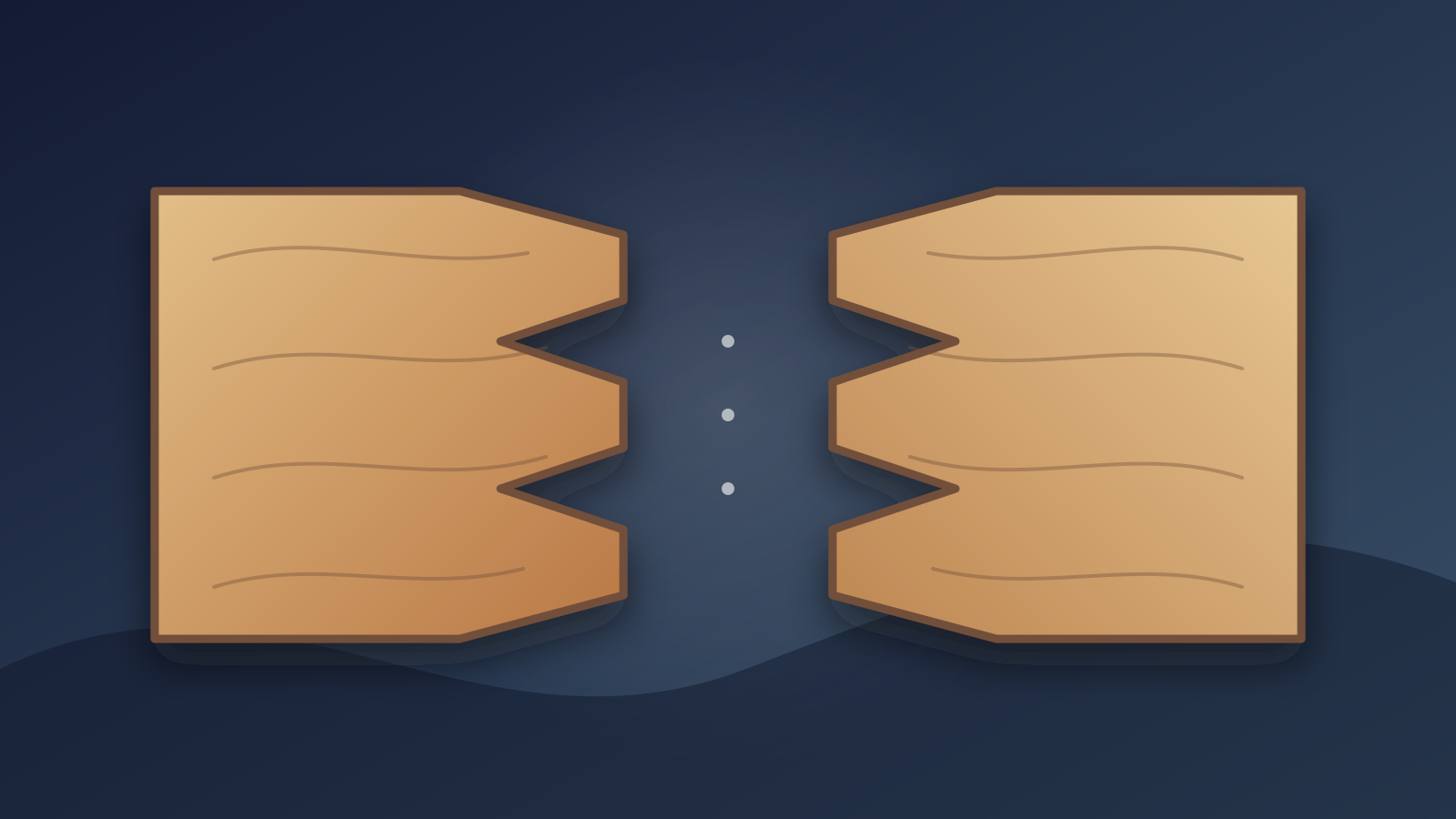
Quick answer: A dovetail drawer is a drawer box whose corners use interlocking, flared pins and tails cut into adjoining pieces of wood. The geometry helps the joint resist pulling apart, especially when it is properly fitted and glued. The joint is one quality clue, while material, bottom construction, slides, fit, and documented specifications still matter.
What a dovetail drawer is
A dovetail drawer uses dovetail joinery at specified corners of the drawer box. The joint connects two pieces at a right angle through matching flared shapes. One piece has projecting shapes that fit into corresponding openings in the other.
The Getty Art & Architecture Thesaurus classifies dovetails as interlocking wood joints. The Architectural Woodwork Institute glossary describes one or more tenons interlocking with corresponding mortises.
The term describes the corner connection. It does not identify the drawer-side material, bottom construction, slide hardware, load rating, finish, or collection by itself.
How dovetail joinery works
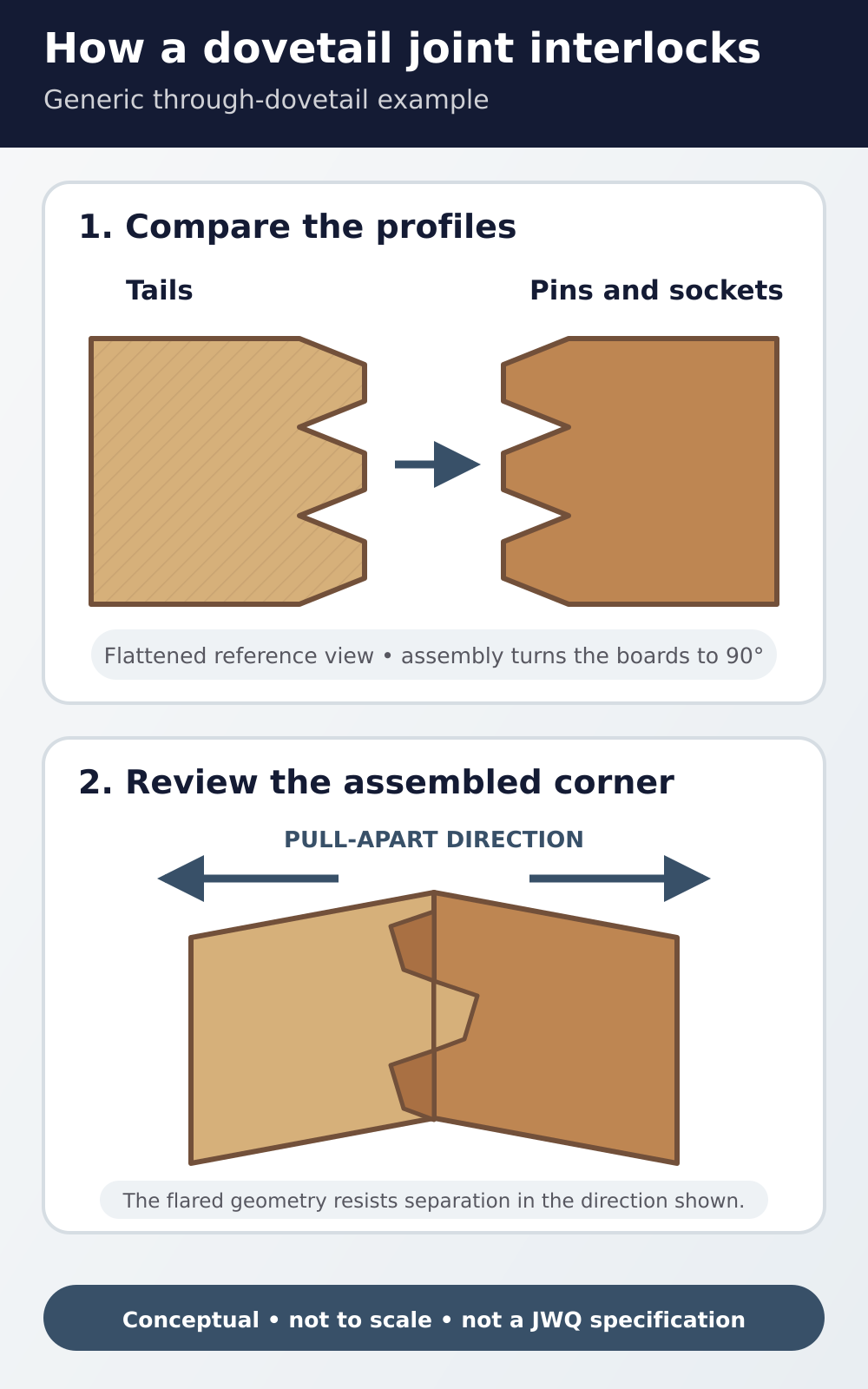
The flared shapes are commonly called pins and tails. Their geometry creates a mechanical lock that resists separation in the direction the drawer front is pulled. A close fit spreads contact across the cut surfaces, while an appropriate adhesive secures the assembled joint.
AWI’s glossary says a glued wooden dovetail joint requires no mechanical fasteners. The USDA Forest Products Laboratory chapter on wood adhesives explains that bond formation and performance require their own evaluation. Those sources do not prove how a particular manufacturer assembles its drawer box, so the current product specification still controls.
Some dovetail patterns remain visible from both faces. Others conceal part of the connection behind the drawer front. Either approach can be made accurately or poorly. The pattern alone does not reveal the fit, adhesive process, material condition, or completed drawer performance.
What dovetail construction can tell you
A visible dovetail gives a dealer, contractor, or buyer an inspectable assembly detail. The joint should be seated consistently, with the matching shapes engaged across the corner. The flared geometry helps resist the pulling force applied when the drawer opens.
Useful observations include the number and spacing of the cuts, the condition of the edges, and whether the adjoining pieces meet cleanly. Large unexplained gaps, split wood, broken edges, or a joint that is not fully seated call for product-specific review.
A clean joint is evidence about that corner. It is not a certificate for the whole drawer or cabinet.
Why the joint alone does not prove drawer quality
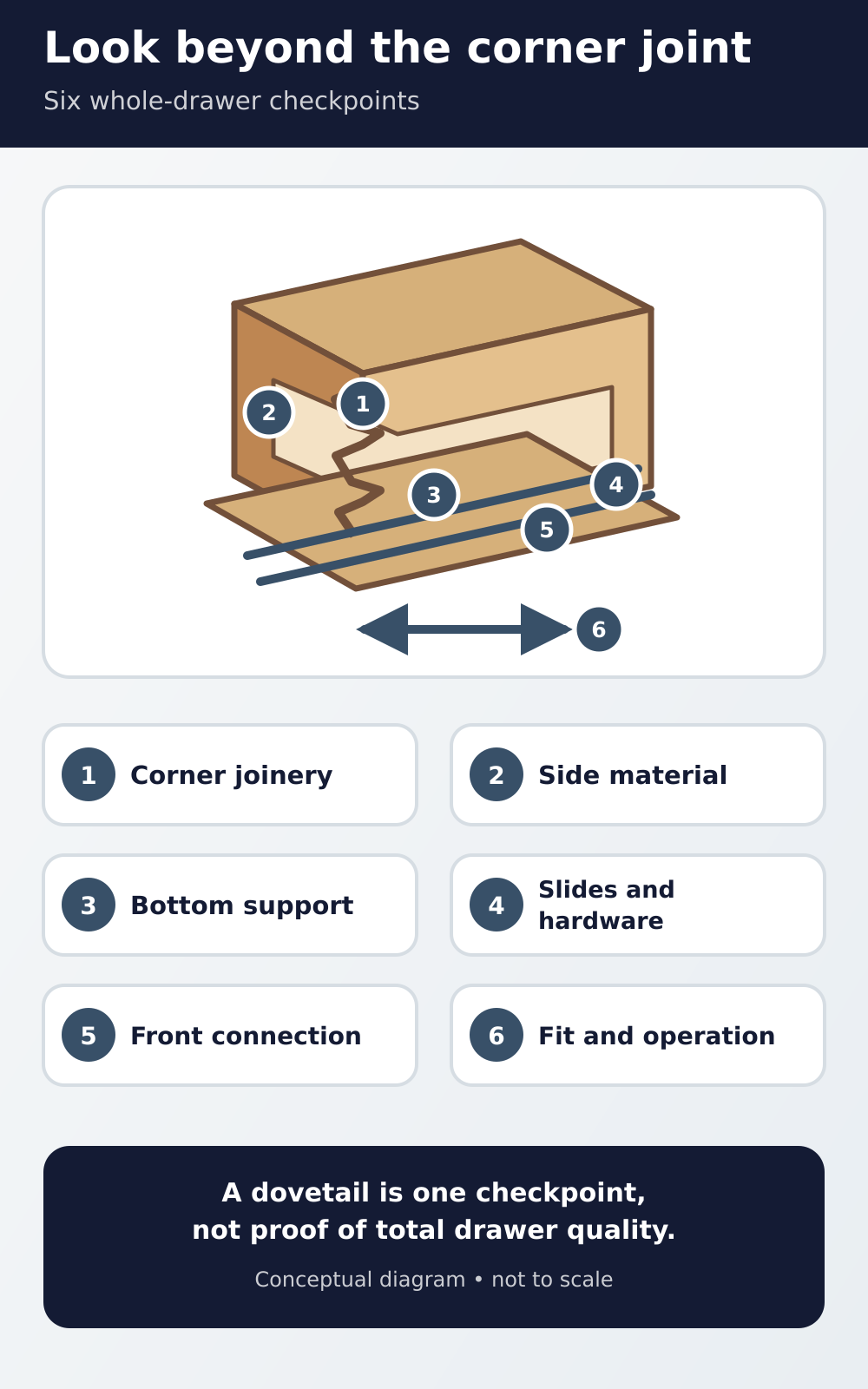
Drawer performance depends on several connected parts. ANSI/AWI 0641-2019 addresses joinery, drawer bottoms, front connections, hardware capacity, and operation as separate considerations within architectural wood casework. Its laboratory loads are test values for that standard, not recommended service loads for a JWQ product.
| Checkpoint | What to verify | Why it matters |
|---|---|---|
| Corner joinery | Joint type, fit, adhesive, and any added fasteners | Shows how adjoining drawer-box pieces connect |
| Drawer sides | Material, thickness, finish, and condition | Affects the box structure and the surface carrying the joint |
| Drawer bottom | Material, thickness, support, and attachment | Carries stored contents and connects to the box |
| Slides | Type, extension, rating, adjustment, and soft-close specification | Controls movement, support, alignment, and closing action |
| Front connection | Attachment and alignment | Transfers pulling force from the front to the box |
| Completed fit | Square box, even gaps, and smooth travel | Shows how the parts operate together after assembly |
The USDA Forest Products Laboratory chapter on wood moisture explains that wood exchanges moisture with the surrounding air and that moisture content affects its properties and performance. Fit, material selection, finishing, storage, and installation therefore matter alongside the joint pattern.
How to inspect a dovetail drawer
Start with the current product schedule, sample, or approved order document. Then inspect the physical drawer under good light.
- Identify the dovetailed corners. Confirm which connections use the joint rather than assuming all four corners match.
- Look at the fit. Check whether the pins and tails are fully seated and whether gaps are consistent with the approved sample.
- Check the material. Confirm the specified drawer-side material and thickness instead of inferring them from the visible end grain.
- Inspect the bottom and front. Review how the bottom is supported and how the drawer front connects to the box.
- Operate the drawer. Open and close it through its full travel. Note binding, rubbing, uneven gaps, or a front that sits out of alignment.
- Verify the hardware. Match the slides, adjustment, extension, soft-close function, and documented rating to the selected product.
Do not use a showroom sample or one collection’s page as the specification for another line. Product details can differ even when the drawers look similar.
Dovetail construction on current JWQ product pages
JWQ’s current Shaker White specifications list a 5/8-inch solid-wood drawer box, a 3/8-inch bottom, dovetailed construction, a natural finish, and concealed full-extension soft-close glides. The current Legend Maple specifications list the same drawer-box and glide details for that named line.
Those are line-specific examples. They do not establish that every JWQ collection has identical drawer construction. Review the selected product page, current order documents, and dealer confirmation before carrying a specification into a project.
JWQ’s broader Cabinet Features page describes soft-closing doors and drawers and the natural finish used inside drawer boxes and rollout trays. Use it for feature context, then return to the named product specification for construction details.
Questions to confirm before ordering
Ask for the current answer to each project-relevant question:
- Which collection and cabinet model are being ordered?
- Which drawer-box corners use dovetail joinery?
- What are the side and bottom materials and thicknesses?
- How is the bottom captured or attached?
- Which slide system, extension, adjustment, and rating apply?
- Are the displayed sample and written specification current?
- Which warranty and replacement-part documents apply to the selected line?
Trade professionals can review how to work with JWQ. Homeowners can use the dealer locator to confirm the appropriate purchase channel. Start with the selected collection and keep the approved specification with the order.
Current product pages, cabinet schedules, approved order documents, and dealer confirmation control the specifications for a selected JWQ collection.
Sources
- Getty Research Institute, Art & Architecture Thesaurus: dovetail joints
- Architectural Woodwork Institute glossary
- USDA Forest Products Laboratory: moisture relations and physical properties of wood
- USDA Forest Products Laboratory: wood adhesives, bond formation and performance
- ANSI/AWI 0641-2019: architectural wood casework structural requirements