
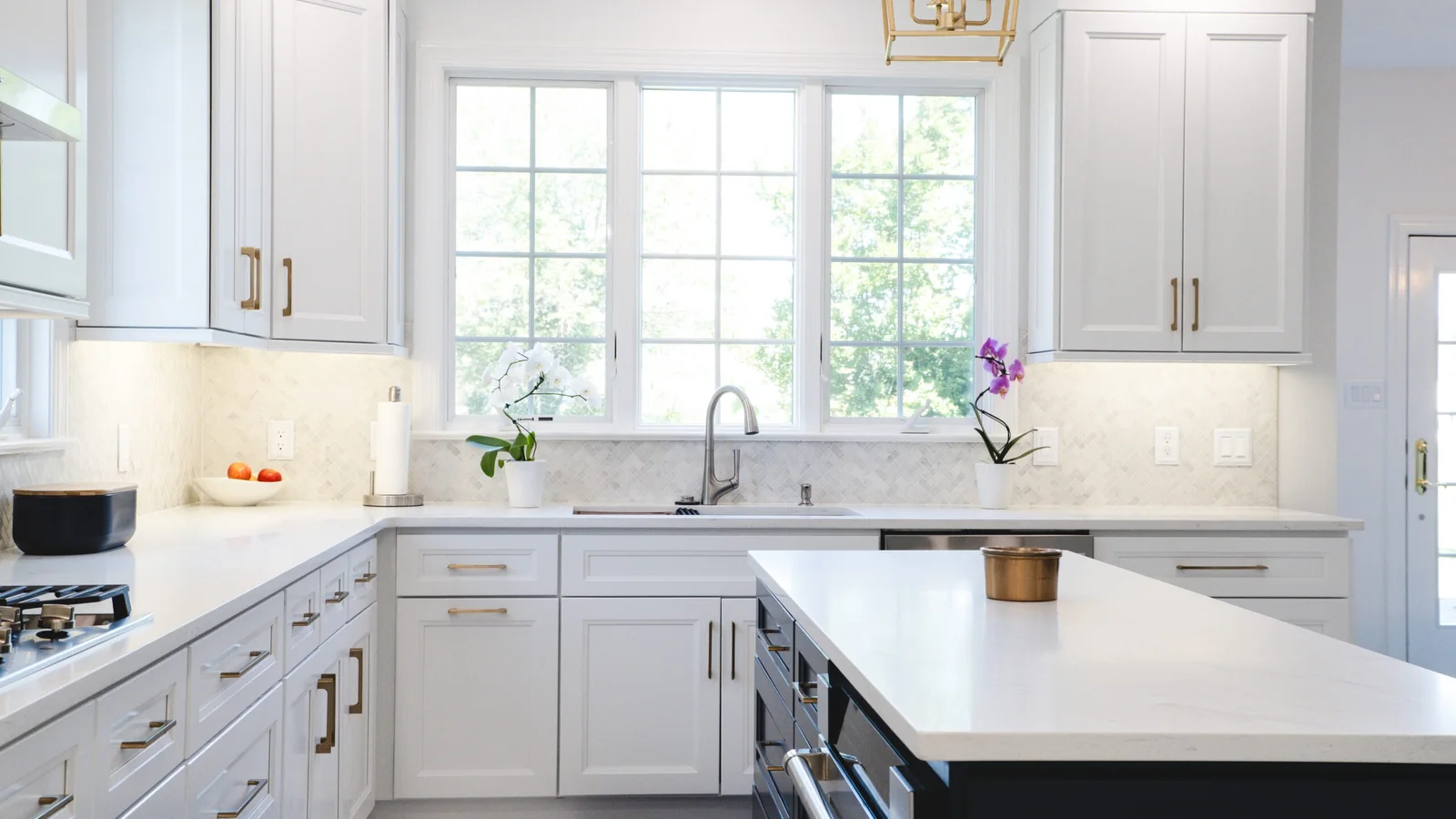
Quick answer: Cabinet knobs are compact handles, usually attached with one screw. Pulls give your fingers a longer gripping area and usually use two screws. Knobs often work well on smaller doors; pulls are a practical starting point for drawers and larger doors. You can use either throughout a kitchen or mix them. Choose for comfort first, then check scale, existing holes, and clearance before drilling.
The difference becomes clearer when you open a loaded drawer rather than look at a finish sample. Hardware needs to suit the person using it, the cabinet front, and the space around it. Here is how to compare the options without turning a style preference into a rule.
What is the difference between cabinet knobs and pulls?
A knob gives you a small gripping point. Round, square, oval, and T-shaped designs can look quite different, even when they share the same finish. Most conventional knobs mount through a single hole.
A pull has a handle you can grasp along its length. Bar, arch, and cup pulls offer different hand positions. Most conventional pulls mount through two holes, although edge pulls and other specialty designs may use a different fixing method.
- Knobs: a smaller visual accent, usually one mounting hole, and a grip that depends heavily on the shape and projection.
- Pulls: a longer visual line, usually two mounting holes, and often more room for several fingers.
- Both: need secure fixings, suitable screw lengths, and enough clearance to operate without hitting nearby surfaces.
Neither type is automatically more durable. Material, construction, finish, installation, and use matter more than the label.
Should you use knobs or pulls on cabinet doors?
Knobs can keep a run of smaller doors visually quiet. They also leave more of a decorative door profile visible. Try the sample with dry and damp hands: a smooth, shallow knob may feel very different from a rounded knob with space behind it.
Pulls are worth trying on tall pantry doors and frequently used base cabinets. A vertical pull can give you a larger gripping area without requiring a pinch around a small knob. Confirm that the handle clears an adjacent wall, appliance, or perpendicular cabinet when the door opens.
Door style helps narrow the look, but it does not dictate the hardware. Both knobs and pulls can suit Shaker cabinet doors. Compare the handle against the width of the surrounding frame rather than choosing from a close-up product photo alone.
Are pulls better for drawers?
For a deep drawer carrying pots or dishes, a pull is a sensible first sample. It provides space to distribute your grip across several fingers. A knob may still work on a small, lightly loaded drawer if it feels comfortable in daily use.
A wide drawer does not automatically need two pulls. One appropriately sized central pull may work well; a two-pull arrangement creates a different appearance and may encourage two-handed opening. Choose with the drawer and hardware specifications in mind, not a universal width cutoff.
Hardware will not fix a drawer that binds or has damaged slides. Check the drawer's operation before blaming the handle, and do not use an ordinary cabinet pull on an integrated appliance panel unless its manufacturer approves that application.
Can you mix knobs and pulls in the same kitchen?
Yes. Knobs on doors and pulls on drawers is a straightforward combination. Another option is pulls on working base cabinets and knobs on upper doors. The important part is repeating a clear pattern instead of changing hardware from cabinet to cabinet without a reason.
Start with one finish and related shapes. A rounded knob and a softly curved pull can feel coordinated without being identical. If you mix metals, compare physical samples beside the faucet, lighting, and cabinet finish under the room's actual light.
Using only pulls is also a complete design choice, not a shortcut. For more context on matching hardware to the door profile, see our guide to choosing a cabinet style.
How to choose hardware size and placement
Do not confuse a pull's overall length with its mounting-hole spacing. Center-to-center means the distance from the center of one screw hole to the center of the other. Two pulls with the same overall length may require different holes.
For replacement hardware, measure the existing hole spacing first. A 3-inch spacing is 76.2 mm, not 96 mm. A replacement labeled 96 mm will not fit those same two holes unless it has a compatible adjustable mounting design.
For new cabinets, use paper outlines or removable samples to compare proportions before deciding. A pull around one-third of a drawer front's width is sometimes used as a visual starting point, not a construction standard. Hand clearance and the actual mounting specification still come first.
On doors, hardware normally sits near the opening edge opposite the hinges. On drawers, a horizontally centered handle is common. Align repeated pieces consistently, but let the door profile, drawer construction, and installer-approved layout determine the final hole positions.
Five checks before you order or drill
- Test the grip. Try the sample with the person who will use it. Check finger room, sharp edges, and whether projecting ends catch clothing.
- Check moving clearances. Open neighboring doors and drawers. Look for contact at inside corners, walls, and appliances, especially with full-overlay cabinet fronts.
- Confirm the fixing details. Match hole spacing, screw thread, and screw length to the hardware and the total thickness being fastened.
- Approve one layout. Have the installer confirm a template on a representative door and drawer before repeating it across the kitchen.
- Count from the final plan. Separate doors, drawers, tall units, and specialty fronts. Keep the selected model numbers and finish names with the order.
When replacing a two-hole pull with a knob, the unused hole remains visible unless the new hardware covers it or the front is professionally repaired. Switching a knob to a pull may also require an additional hole and careful positioning. Check before buying a full set.
Choosing hardware for a JWQ kitchen
Bring your cabinet layout and preferred samples to your dealer. Review door profiles, drawer sizes, opening clearances, and any proposed organizers together. JWQ's cabinet accessories page is a starting point for interior options; it is not a promise that a particular decorative knob or pull is included or available.
Homeowners can find a JWQ dealer to confirm cabinet and hardware choices before ordering. A comfortable sample and an approved mounting layout are more useful than following a style rule that does not fit your kitchen.
Frequently asked questions
Are knobs or pulls more modern?
Straight bar pulls often create a modern look, but simple knobs can work in a modern kitchen too. Shape, finish, scale, and cabinet style influence the result more than the hardware category alone.
Do all cabinet pulls have the same hole spacing?
No. Measure center-to-center spacing and check the exact product drawing. Overall handle length is not a reliable guide to where the screws go.
Should knobs and pulls match?
They do not have to be identical, but repeated finishes and related shapes make a mixed layout easier to coordinate. Compare samples together before placing the order.
Source
Liberty Hardware: How to Choose Kitchen Cabinet Hardware supports the general comparison, sample testing, and center-to-center measurement guidance. Final fixing and placement requirements come from the selected hardware instructions and cabinet specifications.